

The Studio & Gallery
In 1978 Flick and James Hawkins moved to Ullapool in the North West Highlands of Scotland. Since then they have been working in the Visual Arts, opening the Gallery & Studio to the public in 1980.
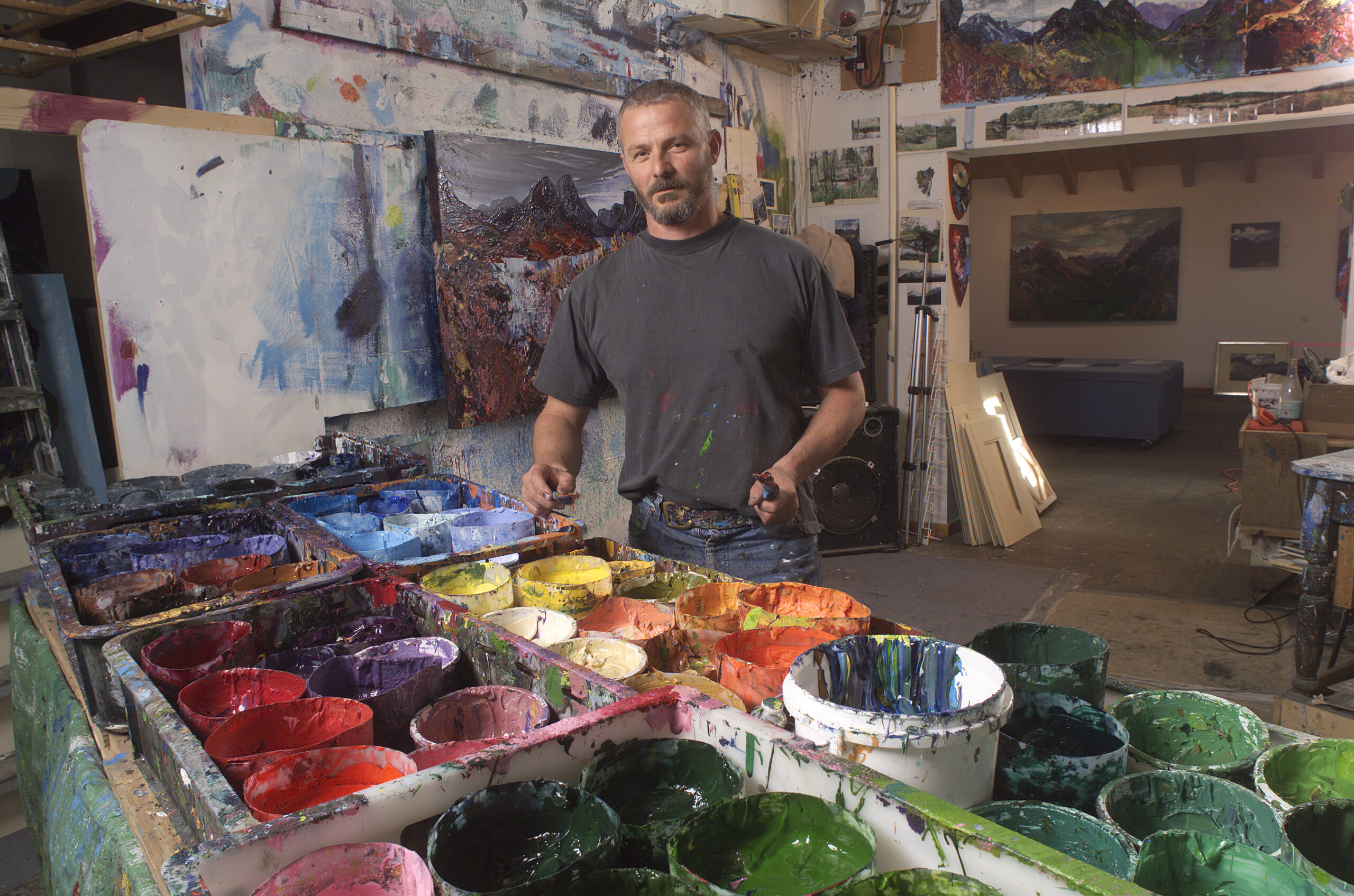


The Studio
I love paint. I know that every day it can throw up a surprise and that is fantastic, it will show me something that it hasn’t before. I just have to keep my eyes open. I mustn’t prejudge or pre-empt what I think I can achieve. This is how to learn anything new. If I take the attitude that paint is a huge exponential explosion that is going to show me lots and lots of possibilities for ever more, then it will. I know that it will never let me down. Fortuitous accidents happen. If I like one, then I re-achieve it in a very controlled way and learn it. So it is a kind of continuing research process where I take some chances, play a bit, and also do deliberate things. It is a dialogue between the two.
The wiggly water that I do, reflections across water, actually came as a result of total frustration at the end of an afternoon of painting. I had been struggling to get the surface of the light coming across the water and I was really cheesed off. I realised I was going to get nowhere until I actually took all the existing layers of paint I had on the surface off, before I put any more on. For some reason, as I dragged that paint off with a piece of card, I thought I wonder what happens if I wiggle it from side to side? It was one of those kind of eureka moments where you think, I couldn’t have done that if I’d tried.


I have often thought of the mind’s eye as a camera on a long telescopic boom, if I think in this way it is possible to picture the same scene from different viewpoints, a little to the left maybe, looking up from below or down from above. When I look at a blank canvas I don’t see a flat surface, I see a receding three-dimensional space that I can populate by placing “objects” behind, below, above, or in front of each other.
To put movement in a painting that is a fixed, static object would seem to be a contradiction. Primary colour theory teaches that complimentary colours in close proximity vibrate with each other; just as tonal colour recession can help with the illusion of depth, so a disparate grouping of secondary and primary colours placed together will flicker and draw our gaze from one part of a picture to another, the movement of the viewer’s eye animating the painting.
“Trying to paint the colour of the wind“
Tom Bryan

James Hawkins succeeds where so many have failed, because unlike them, he doesn’t begin with the sensation of seeing light but of seeing paint. Whereas many artists try to make paint imitate light, Hawkins discovers light in paint. He clearly loves the stuff; he scraps it, lets it run and stops it, he drags it around and cuts into it, when it’s wet or dry. He pushes paint to its limits, like no one I know, and yet you always know its paint. He never lets it lose its identity to represent something else. And yet the magic is that it does.
Julian Spalding

The Gallery
Flick began working with Highland Arts in 1995, a government agency set up with funding from E.R.D.F. (Europe Regional Development Fund) whose aim was to help market and promote the artists from the area. Over the years Flick has helped curate exhibitions and has shown work at Art fairs nationally and internationally, building up a close working relationship with artists from all areas of the Highlands and Islands of Scotland.
When the funding finished for Highland Arts, Flick decided to utilise her expertise and contacts to develop Rhue Art into an international platform to promote and represent some of the best Artists working in the area today.
The Gallery is set on the shore of Loch Broom, just outside the small fishing village of Ullapool on the Far North West coast of Scotland. We are open all year by appointment.

